
A 3D billboard is basically a large format outdoor display that makes use of optical illusions, anamorphic designs or digital technology in order to make images appear to extend beyond the flat surface of the screen.
It has become one of the most attention-grabbing formats in the advertising world as of now and it is consistently outperforming traditional billboards and static advertising in terms of engagement, recall and shareability.
3D billboard advertising is no longer considered a novelty, rather it has become a proven format generating measurable returns for brands.
What Is a 3D Billboard and How Is It Different From a Regular Billboard?
A 3D billboard helps create an illusion of depth on a flat or curved screen or surface – making the visual appear to leap off the display and into the space around it. Traditional flat billboards display only graphics on a single plane with no sense of movement or dimension.
2D billboards rely on design and copywriting alone whereas 3D displays add a third dimension which means perceived depth, motion and presence. All of these three fundamentally change how people experience the billboard ad.
Unlike traditional billboards, 3D billboard formats use forced perspective, multi-angle design, or even augmented reality overlays in order to create an illusion that the featured content is part of the real world around it.
How Do 3D Billboards Work?
In simple words, 3D billboards work by exploiting the way your eyes perceive depth.
Each eye captures a slightly different angle of the same scene. This concept is called stereopsis. 3D billboards exploit this by merging two images taken from different angles and engineering a combined visual that the brain reads as three-dimensional. This creates an illusion of depth and effect without needing special glasses or any headset filter.
- Anamorphic billboards, which are the most common format, often use a distorted image designed to appear correctly proportioned only from a specific vantage point. So, when a commuter passes through that viewpoint – the image appears to pop out of the screen with full volume as well as presence. The forced perspective technique essentially manipulates angle along with geometry so the 3D effect registers naturally at a viewing distance.
- LED screens and LED billboards are the standard hardware for delivering 3D billboard content. They typically run at 4K with high-resolution LED panels that offer 16-bit high-grayscale technology. This, in essence, produces the depth & realism that makes 3D billboards appear lifelike rather than digital.
3D LED billboard displays also can easily auto-regulate brightness for visibility in all conditions be it daylight direct sun or even night time this makes them consistently high resolution no matter what type of environment that is being displayed.
What Are the Advantages of 3D Billboard Advertising?
There are several advantages of 3D formats over static and two-dimensional billboards.
- According to research by BCN Visuals cited by Rock Paper Reality almost 68% of consumers find anamorphic billboards make their brands appear more premium, and 66% are more likely to purchase the product after seeing this type of ad. On shareability, 50% of viewers often say that they are likely to share an anamorphic ad experience in person and 58% via an application.
- 3D billboard technology can also drive organic reach. Because immersive and interactive formats prompt people to film and photograph the display, that content is then circulated across different types of social media platforms that extends the 3D billboard campaign reach far beyond the immediate footfall at the placement location.
- The immersive nature of 3D ads also helps produce a very strong emotional response as compared to flat formats, which directly influences brand loyalty as well as purchasing intent. The impact of 3D billboards on consumer behavior is not just passive, but it is participatory.
Examples of 3D Billboards That Defined the Format
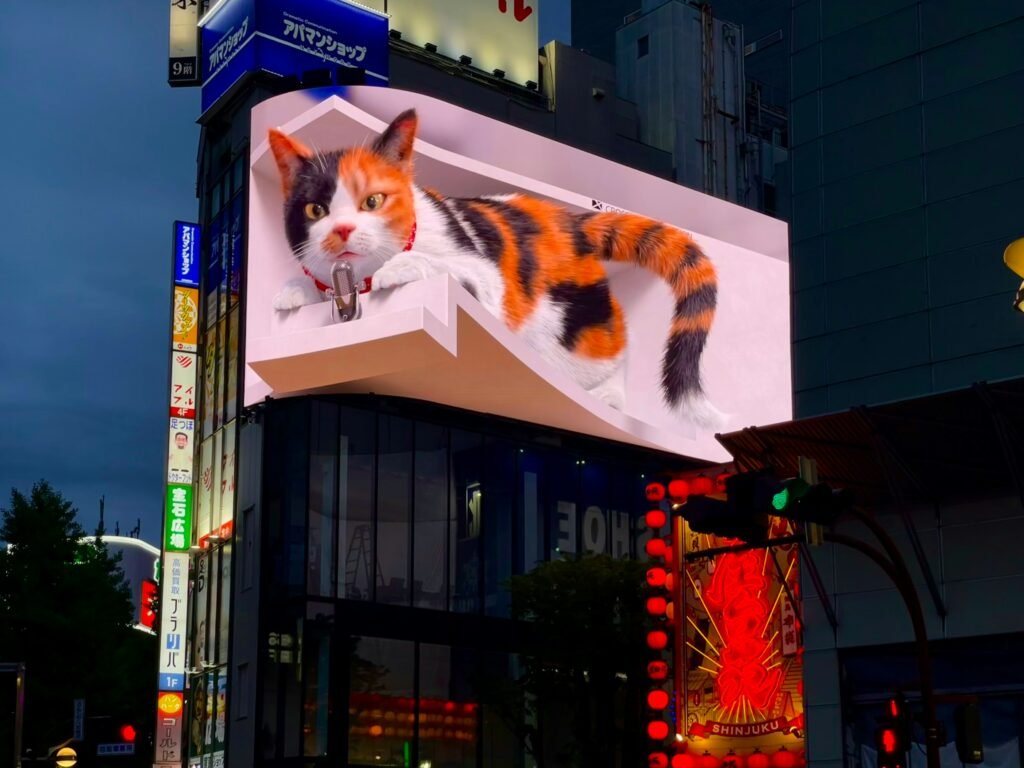
Below are some of the best examples of 3D billboard advertising that have actually defined the format and make them a proven choice for brands:
Shinjuku Cat: Nike Japan Air Max
Right at Tokyo’s popular Shinjuku station, Nike Japan used the famous Giant Cat 3D billboard in order to launch their Air Max sneaker line. Various models emerged from the sliding Nike box and appeared suspending mid-air next to the billboard, highlighting the range before the Nike box retracted with the cat’s paw providing the send-off.
The campaign became one of the most referenced examples of 3D outdoor advertising on a global scale. Such an eye-catching 3D execution of 3D billboard ads turned the product launch into a cultural
Meta Quest 2:Piccadilly Circus
Meta Quest 2 used a 3D billboard right at London’s Piccadilly Circus in November 2022 in order to promote their VR headset. They displayed an NFL player that was catching a ball and an astronaut appeared to drift out of the display – the entire visual directly communicated the immersive promise of the product through lifelike 3D content.
Times Square 3D Ad Campaigns
Times Square has hosted some of the most famous and significant milestones to be recorded in the 3D advertising world. Coca-Cola displayed the largest dynamic 3D billboard at Times Square in the year 2017.
Adler Inc. then pushed further by displaying a 3D ad at Times Square in May 2023 with over 67,000 personal messages that were displayed using a QR code that allowed visitors to generate personalized content instantly on location, according to Rock Paper Reality.
How Do You Measure 3D Billboard Campaign Effectiveness?
Measuring digital billboard advertising campaigns effectiveness requires a combination of metrics which include:
- Foot Traffic & Views: This advanced tracking estimates the number of people who pass the 3D LED billboard location and provides raw impression data.
- Social Media Amplification: Hashtag usage, shares and mentions which are generated by people that are filming and photographing the display.
- Ad Recall: This is a survey-based measurement of how well viewers remember your billboard ad and your brand.
- Conversion Tracking: This means tracking the website visits, QR codes scans and sales data before and after the 3D billboard campaign started to run.
Using 3D billboards without these primary tracking metrics can leave a very significant portion of campaign insight unmeasured, in particular, the organic social reach – which often exceeds the direct footfall exposure.
Also Read: Billboard Advertising Design Ideas That Actually Work
Conclusion
3D billboard advertising is meant to deliver that flat formats cannot offer – genuine surprise, element, organic sharing, and the kind of lasting impression that can turn a brand moment into a cultural one.
Normal billboards stand out in any urban environment, but 3D billboards stand apart from everything around them. The impact of 3D billboards is measurable at every level, be it brand recall, purchase intent, sound, social amplification, or foot traffic.
The immersive nature of 3D formats has consistently produced stronger emotional engagement than static billboards and traditional flat outdoor ads. For brands that genuinely want to captivate their audience, leave a lasting impression & unlock new possibilities in the outdoor advertising world, 3D billboard advertising is the format that can deliver it at scale, in the real world.
At Selvel One, we are experts in operating large-format outdoor advertising networks and can help brands plan, execute & showcase impactful dooh advertising that actually commands attention. Contact our team today in order to know what the right digital advertising placement strategy can do for your next campaign.
FAQs
Q: What is a 3D billboard?
A 3D billboard can be explained as a large-format advertising medium that uses 3D technology like anamorphic optical illusions, LED-based dynamic content, or even forced perspective to give viewers the experience of seeing depth & dimension. Unlike digital displays, a 3D billboard creates perceived motion & volume that stops people midway to generate organic sharing across social platforms.
Q: How do you make a 3D advertisement?
The advertisement generally uses advanced CGI modeling along with rendering to create content that is particularly designed for viewing from a certain angle. The creative process merges images from slightly different perspectives so that the brain reads them as a combined output. Plus the use of digital signage software can help manage playback, ensuring accurate perspective, depth and motion are maintained consistently across the screen at a viewing distance. The result is a masterpiece of content built for its physical environment.
Q: What is a 3D marketing strategy?
3D marketing strategy, to be exact, makes use of 3D digital billboards and immersive outdoor formats as part of a broader advertising landscape plan. This includes combining large format anamorphic or AR-enabled placement with digital retargeting, social amplification, QR-driven engagement, and much more in order to amp up the brand’s awareness at street level and then extend reach across channels.